Cardiac Tests
Stress Testing
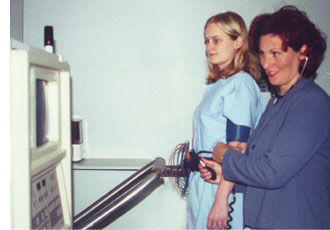 Stress
testing is also known as treadmill testing or graded exercise testing.
During the test you will be asked to walk on a treadmill which gradually
increases the speed and grade. Your electrocardiogram, blood pressure
and symptoms will be continuously monitored. The test will be stopped
when your symptoms warrant it or if a strongly positive result or arrhythmia
occurs. Treadmill testing is useful to assess the presence and severity
of coronary artery disease, and if present to determine the prognosis
and to guide therapy or intervention. Stress
testing is also known as treadmill testing or graded exercise testing.
During the test you will be asked to walk on a treadmill which gradually
increases the speed and grade. Your electrocardiogram, blood pressure
and symptoms will be continuously monitored. The test will be stopped
when your symptoms warrant it or if a strongly positive result or arrhythmia
occurs. Treadmill testing is useful to assess the presence and severity
of coronary artery disease, and if present to determine the prognosis
and to guide therapy or intervention.
A treadmill test may be carried out shortly after a heart attack to determine
your risk for a future heart attack or for angina. The most common way
to do this is to increase speed and grade every 3 minutes. In this case,
the treadmill test is usually limited either by a time or a heart rate
maximum. Later a full exercise test may be carried out.
Treadmill testing may show changes in the electrocardiogram (ECG) which
may mean the blood supply to your heart is reduced. Chest pain or shortness
of breath may accompany these changes. Unfortunately treadmill testing
is not perfect. About 30% of the time false positive results may be obtained.
This may make further testing necessary to rule out coronary disease or
assess its severity.
For more information, please refer to the Pre-Stress
Test Instructions.
|