












Atrial Fibrillation
Decision Aide
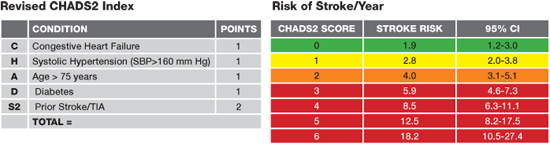
The information about the likelihood of stroke over one year that is
provided will depend upon your risk factors. Risk factors for stroke in
atrial fibrillation include: age, hypertension (HTN), diabetes (DM), congestive
heart failure (CHF) and prior stroke (CVA) or transient ischaemic attack
(TIA). The table presents the risk of stroke over one years of
follow-up stratified by age and risk factors. Guideline recommendations
are based on the Sixth (2000) ACCP Guidelines for Antithrombotic Therapy
for Prevention and Treatment of Thrombosis (CHEST
2001; 119, supplement)

Warfarin (Coumadin“) therapy requires frequent blood monitoring
of prothrombin time (PT) or INR. Patients with atrial fibrillation require
an INR optimally of 2.5 (range between 2 and 3). Coumadin dose is adjusted
according to blood tests to maintain the INR in the therapeutic range.
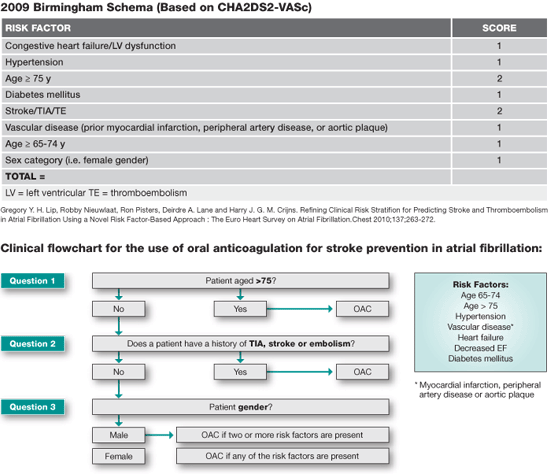
Patients with atrial fibrillation and structural heart disease:
hypertensive heart disease, coronary heart disease with LV dysfunction,
rheumatic valvular heart disease, congenital valvular heart disease (bicuspid
aortic valve with AS, MVP), hypertrophic cardiomyopathy (obstructive or
non-obstructive), idiopathic dilated cardiomyopathy or complex congenital
heart disease are at high risk for stroke.
Decision:
No anti-thrombotic Rx
ASA
Warfarin
__________
|